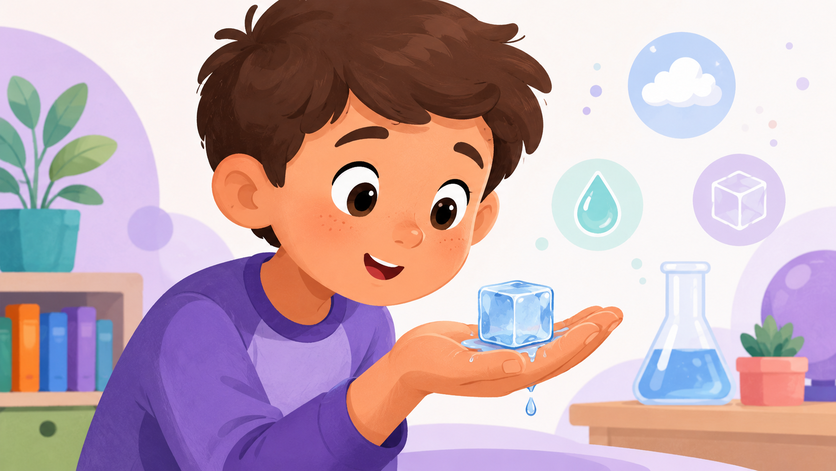
Picture your child holding an ice cube on a warm afternoon. A few minutes later their hand is wet, and the ice has almost gone.They look up and ask, "Where did it go?" That one question is the doorway into one of the most exciting topics in primary science: materials and the states of matter.
In Year 3 and Year 4, children start to make real sense of the world around them. They notice that a chocolate bar melts in a warm pocket, that puddles dry up after rain, and that water left in the freezer turns hard. This guide shows you how to turn those everyday moments into real learning, both in the classroom and at the kitchen bench.
What Your Child Will Learn About States of Matter
By the end of this topic, your child will be able to do the following
- Sort everyday things into three states of matter: solids, liquids and gases. A rock is a solid, juice is a liquid, and the air inside a balloon is a gas.
- Explain that adding heat or taking heat away can change one state into another. Heat turns solid butter into liquid, and the freezer turns liquid water back into solid ice.
- Point to changes of state in daily life, such as a melting ice block, steam rising from a hot bath, or frost forming on a cold morning.
- Predict what heat will do to a material, then test it and watch closely. They might guess that a crayon melts faster than a stone, then check if they were right.
Big Questions That Spark Curiosity
Good science begins with wonder, not with answers.When children ask their own questions, they stay curious and remember far more.Encourage your Year 3 or 4 learner to sit with questions like these.
- What can I notice about this material, and can I change it?
- What happens when I heat it or cool it?
- Can I change a material into a new state and then change it back?
- What happens when I mix two materials together, and what do I get?
- Why is one material better than another for a certain job?
- How would I choose the right material to design and build something useful?
There are no wrong answers at this stage. The goal is to keep them asking.
Helping Children Think and Work Like Scientists
Knowing facts is only half of science. The real skill is learning how to find things out. Here is how to guide your child through the five steps that scientists use.
Questioning and Predicting
Set up a "question wall" at home or in class where children pin up their wonderings. Give them sentence starters to get going, such as "I wonder what would happen if..." and "I predict... because...". A prediction is simply a smart guess based on what they already know.
Planning and Conducting
Help your child design a fair test. The rule is simple: change one thing and keep everything else the same. If they are testing how fast things melt, they melt each item in the same spot for the same length of time. Add simple tools like a ruler, a thermometer or a timer so their observations turn into measurements.
Processing, Modelling and Analysing
Once children collect their results, help them make sense of the numbers. Start with drawings, move on to tally tables, then build a simple column graph. Then ask one key question: "What pattern do you notice?" Patterns are where the learning happens.
Evaluating
Look back together. Ask, "Did our result match our prediction? What surprised us? What would we change next time?"Comparing the guess to the result teaches children that a wrong guess is useful, not embarrassing.
Communicating
Let your child share what they found. A science journal, a labelled diagram or a short talk all work well. Teach the simpleClaim, Evidence, Reasoning pattern: state what you found, show your proof, then explain why it makes sense.
Hands-On Activity One: Heat and Change of State
This activity follows the trusted 5E model and helps your child describe how adding or removing heat causes a change of state.Useful prompts to ask along the way: "What happens to ice when we add heat? How could we turn it back into a solid? What caused the change?"
- Engage: Run a melting race. Place an ice cube, a square of chocolate, a knob of butter and a crayon in the sun or under a lamp. Ask your child which one will melt first, then watch and wonder.
- Explore: Carry out a fair-test melt. Freeze, melt and then evaporate water, recording what you see and the temperature at each step.
- Explain: Introduce the words solid, liquid and gas. Show that adding heat drives the change one way, and removing heat drives it back. Map which changes can be reversed.
- Elaborate: Try Predict, Observe, Explain with new materials. Link it to the water cycle, where water evaporates into the air and later condenses into clouds and rain.
- Evaluate: Ask your child to draw and label a state-change cycle with arrows that read "heat added" and "heat removed", then predict the outcome for a brand new situation.
Hands-On Activity Two: Choosing the Right Material for the Job
This second 5E activity helps your child investigate whether natural and processed materials suit different purposes.Guiding prompts: "Which material is most suitable for this job? What property makes it suitable? How does your evidence support your choice?
- Engage: Ask, "Why is a raincoat made of plastic and not paper?" Pass around a few mystery materials and let children link each property to a possible purpose.
- Explore: Run fair tests on material properties such as waterproof, strong, flexible and absorbent. Keep the tests simple and controlled, then record the results in a table.
- Explain: Sort the materials into natural and processed groups. Match the properties they observed to common everyday uses
- Elaborate: Set a design challenge. Children pick the best material for a product such as an umbrella, a lunchbox or a shopping bag, using their test evidence to decide.
- Evaluate: Children justify their choice with their data, then review each other's designs against a set of agreed standards.
How NotesEdu Brings Science to Life
Some science ideas are hard to picture with words alone. This is where NotesEdu helps, and the best part is that you can start for free.
Your child can step inside a free 3D immersive experience where a tap of the screen heats and cools materials. They watch ice melt into water, then water rise as vapour. This builds a clear mental picture of each state of matter and grows real understanding.
The platform also turns that curiosity into action.Free quizzes let children predict an answer, check it, and compare it with what they expected, so they learn to question and test their ideas. Free hands-on activities guide them to plan a fair test and carry it out step by step.
Downloadable worksheets and science journals give them a ready-made place to record results, spot patterns, and present their findings using proper science words.
In short, NotesEdu supports every part of the science journey, from sparking wonder and building knowledge to questioning, planning, investigating, analysing, evaluating and sharing what they learn.
Start Exploring Today
Curiosity grows when children get the chance to ask, test and discover. You can support that today with NotesEdu's free science resources.
Tap the links below to claim your free tools:
- Free 3D immersive states of matter experience
- Free interactive science quizzes
- Free hands-on activities and downloadable worksheets