Watch a primary student finish their first sentence in flowing cursive, and you'll see something shift in their eyes. Their shoulders drop, their grip relaxes and a small smile creeps in. Handwriting is more than a school skill. It builds focus, fine motor control and confidence, and it stays with children long after the lesson ends.
This guide gives teachers and parents a clear path through student handwriting. You will learn the right posture and grip, the five letter families, the four main cursive joins and the free NotesEdu resources that turn daily practice into real progress.
Set the Stage: Posture, Grip and Paper Position
Good handwriting starts long before the first letter. The body, the hand and the paper all need to work together.
Sit ready to write
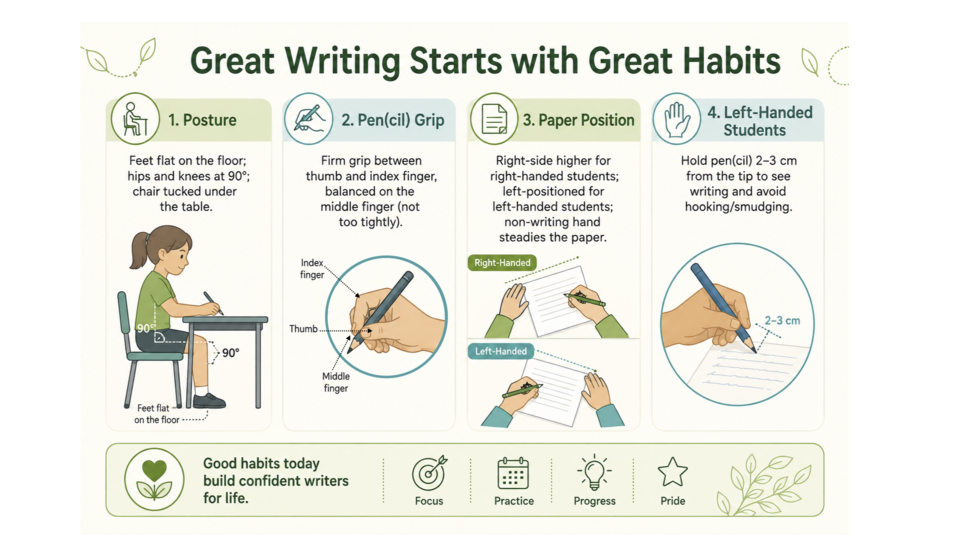
Ask your child to sit with their feet flat on the floor. Their hips and knees forma clean 90-degree angle. The chair is tucked under the table, so the writing arm rests easily on the surface. This balanced base steadies the whole body and frees the hand to move.
Hold the pencil with care
The pencil sits in a firm but relaxed pinch between the thumb and the index finger.The middle finger supports the pencil from below. The grip should never feel tight. A clenched grip tires the hand and slows the writing.
Place the paper at the right angle
For right-handed children, tilt the paper so the right side sits a little higher.For left-handed children, place the paper to the left and tilt it the other way. The non-writing hand stays on the paper to keep it steady.
Help left-handed writers shine
Left-handed children often struggle with hooked wrists and smudged ink. A simple fix helps.Ask them to hold the pencil 2 to 3 centimetres from the tip. They can now see their writing clearly as it forms, and the ink has time to dry.
Know Your Letter Families
When children see letters as members of families, handwriting becomes easier to learn. Each family shares the same starting move.
- Down letters start with a straight line down: i, j, l, t.
- Clockwise letters loop in the same direction as a clock: b, h, k, m, n, p, r.
- Anti-clockwise letters loop the other way: a, c, d, e, f, g, o, q, s.
- Diagonal letters are built from slanted strokes: v, w, x, z.
- Down-up letters drop down then swing back up: u, y.
Some letters also reach beyond the middle of the line.
Ascenders, also called tall letters, stretch upwards: b, d, f, h, k, l, t.
Descenders, also called tail letters, dip below the line: g, j, p, q, y and f. Knowing which letters are tall and which have tails helps children space their writing and join them well.
The Magic of Joins: ConnectingLetters Smoothly
Once children form each letter cleanly, the next step is to join them. Joining gives writing speed and rhythm. There are four main joins to learn.
Diagonal joins to short letters
The exit hook of the first letter rises to the next letter at a smooth 45-degree angle. This is the most common join and a great place to start.
Diagonal joins to tall letters
When the next letter is tall, the exit hook climbs all the way up to the top line. The pencil then retraces down to form the tall letter. The line still flows, but the writer travels a little further.
Diagonal joins to anti-clockwise letters
This join is also called a "drop-in" or "back touch". The exit of the first letter reaches the top of the next letter. The pencil lifts and the anti-clockwise letter is dropped into place. This small lift keeps anti-clockwise letters clean and round.
Horizontal joins (neck line joins)
Some letters finish near the middle of the line, including f, o, r, v, w and x.These letters use a horizontal join, often called a "neckline" join, with a small dip across to the next letter.
Letters that do not join
Some letters end with a stroke that does not lead naturally into the next letter.These are the no-join letters: b, g, j, p, s and y. After writing one of these, lift the pencil before starting the next letter.
How NotesEdu Helps Your Child Build Handwriting Confidence
Strong hand writing needs steady, daily practice. NotesEdu makes practice easy, structured and fun.
Practise with purpose
NotesEdu's curriculum-linked questions and Writing Course give children real reasons to write. The more they write with purpose, the more naturally their grip relaxes, their letters even out and their joins flow.
Build fluency through writing
Children who write longer answers and short stories on NotesEdu develop the muscle memory good handwriting needs. The Writing Course adds expert feedback, so children learn to write with both clarity and care.
Track progress and stay motivated
Detailed reports help parents and teachers see exactly where a child is improving and where to focus next. Small wins keep children excited to pick up the pencilagain.
Start for free today
You can begin without spending a cent. Try the free downloadable handwriting and writing materials from NotesEdu by clicking the links below:
- Download free resources
- Browse the free tests
Frequently Asked Questions
At what age should children start cursive handwriting?
MostAustralian schools introduce cursive in Year 3, once children have mastered clear printing.
How long should daily handwriting practice be?
Ten to fifteen focused minutes a day works better than long, tiring sessions.
My child is left-handed. Will they struggle with cursive?
Not at all. Left-handed children can write beautifully with the right paper angle and a pencil grip 2 to 3 centimetres from the tip.
Does handwriting still matter in a digital world?
Yes.Handwriting builds focus, memory and fine motor skills that typing alone cannot give.
Help Your Child Write with Pride
Every smooth, confident letter your child writes is a small win. With the right posture, the right grip and a little daily practice, Year 3 and 4 students can move from wobbly letters to flowing cursive in just a few weeks. Start their journey today with NotesEdu's free downloadable resources.