


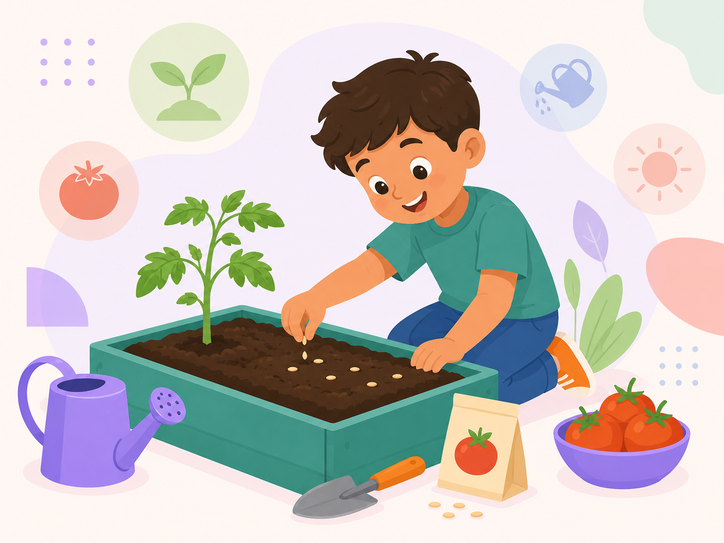
Hand a seven-year-old a packet of tomato seeds and watch what happens. The questions pour out. Why are the seeds so small? How does something this tiny turn into a salad? Will it grow faster on the window sill or in the cupboard?
That spark is exactly what the Year 3 and 4 food and fibre topic is built on.This guide shows teachers and parents how to turn everyday food, fabric and gardening into real science, one simple step at a time.
What Food and Fibre Science Means
Food and fibre science sits inside Design and Technologies in the Australian Curriculum. In Year 3 and 4, children explore where our food and clothing come from, and why some materials suit some jobs better than others.
Try this at the kitchen table. Place a strip of wool, a square of cotton and apiece of plastic in front of your child. Ask them which one would keep a lambwarm, which would make a cool summer shirt, and which would make the bestraincoat. As they feel, stretch and compare each one, they are investigatinghow the properties of materials decide where we use them.
Then sort items into two groups. Natural materials come straight from plantsand animals, such as cotton, wool and apples. Processed materials are changedby people first, such as tinned tomatoes, bread and denim. This quick sortinggame gets children thinking like designers in minutes.
Three Big Questions That Spark Curiosity
Curiositygrows when children chase a big question. These three questions open up thewhole topic:
- How do we make food and fibre products from plants and animals?
- Why does it matter that food and fibre are grown in a sustainable way?
- Can we design a healthy meal using food and fibre products?
Write one question on a card and stick it on the fridge or the classroom wall.Return to it each day. A single question can carry a whole week of learning.
Turn a Big Question Into aHands-On Project
Pick the third question and run with it. Children can design, plan and produce asmall system that grows food for a healthy meal.
Here is one project that works at home or in class. Grow a pot of lettuce, spinachor herbs on a sunny windowsill. The goal is simple. Produce enough leaves for ahealthy wrap or salad.
Guideyour child through three clear steps:
- Design the grow space. Choose a pot, some soil and a sunny spot. Talk about what a seed needs to grow.
- Plan for sustainability and time. Reuse an old container instead of buying one. Collect rainwater for the plants. Work out how many weeks the leaves need before they are ready.
- Produce the meal. When the leaves are ready, build a healthy wrap together and talk about the journey from seed to plate.
Along the way, children weigh up real choices, such as which container to reuseand how to save water. This is how they develop a design solution for a realneed while thinking about sustainability and time.
The Five Science Inquiry SkillsChildren Build
Onesmall investigation can build every science inquiry skill in the curriculum.Use this question for the examples below: does a seed grow faster in sunlightor in shade?
Questioning and Predicting
Starta question wall where children pin their wonderings. Give them sentence stemsto get going, such as "I wonder what would happen if..." and "Ipredict... because...". A child might write, "I predict the seed inthe sun will grow taller because plants need light."
Planning and Conducting
Plana fair test together. The rule is simple. Change one thing and keep everythingelse the same. Place one pot in the sun and one in the shade, but give both thesame water, soil and seeds. Hand children simple tools to measure with, such asa ruler for height and a thermometer for warmth.
Processing, Modelling andAnalysing
Helpchildren record what they see. Start with a drawing, move to a tally table,then build a column graph of plant height over the days. Point to the graph andask, "What pattern do you notice?" This turns a pile of numbers intoa clear story.
Evaluating
Lookback at the prediction together. Ask three questions. Did our result match ourprediction? What surprised us? What would we change next time? This teacheschildren that a surprising result is still a great result.
Communicating
Letchildren share what they found. They can keep a science journal, draw labelleddiagrams, or give a short talk to the family or class. Teach a simple Claim,Evidence and Reasoning sentence, such as: "Seeds grow faster in sunlight(claim) because the sunny plant grew 4 cm taller (evidence), and plants uselight to make their food (reasoning)."
How NotesEdu Supports Curious Young Scientists
NotesEdugives teachers and parents a simple way to take this topic further. Best ofall, the resources below are free.
- Build knowledge and understanding. Step inside the FREE 3D immersive food and fibre experience and watch how a plant or animal becomes a product. Seeing it in 3D makes a tricky idea easy to picture.
- Grow inquisitiveness. The FREE quizzes ask the kind of "what if" and "why" questions that keep children wondering long after the lesson ends.
- Strengthen inquiry skills. The FREE hands-on activity walks children through questioning, planning, recording, evaluating and sharing, the same five skills above.
- Keep learning at home. The FREE downloadable material, including worksheets and recording sheets, lets families practise the topic any time.
Click any link, explore together, and let your young scientist lead the way.
Easy First Steps for Teachers and Parents
Youdo not need a laboratory to begin. Try one of these this week:
- Sort the pantry into natural and processed foods.
- Plant three seeds and start a height chart.
- Write one big question on the fridge and talk about it at dinner.
Small steps build big curiosity. Start today, and watch your Year 3 or 4 child begin to think, question and discover like a real scientist.


